Write the operating concept early
An operating concept explains how the venue intends to deliver its programme. It should connect opening patterns, user groups, water settings, staffing and maintenance windows. Without it, the design team may optimise a facility for an imagined busy day while overlooking the ordinary weeks that determine whether the venue is sustainable.
Identify the organisation that will own the assets, the team that will operate them and the parties responsible for specialist maintenance. These roles may sit in different contracts. Clear interfaces help prevent gaps in inspection, record keeping and authority to restrict use when conditions change.
Treat energy as a programme constraint
For pumped facilities, energy demand depends on discharge, head, equipment efficiency and the duration of operation. A useful business case considers several realistic operating scenarios rather than a single optimistic annual total. Include quieter periods, partial availability and the effect of maintenance or plant outages on the training programme.
Variable operation may offer flexibility, but it must remain within the assessed hydraulic and equipment envelope. A lower water setting is not automatically appropriate for every user, and frequent switching may introduce practical complications. Engineers and operators should examine the relationship between energy choices, feature behaviour and session scheduling together.
Manage water as an asset and obligation
Water supply, losses, treatment and discharge arrangements depend on the site. Evaporation, leakage, splash and maintenance activities can affect a recirculating system; river-connected venues may face different constraints around abstraction, flow variation and environmental permissions. Avoid assuming that the water balance is resolved simply because the main channel recirculates.
Water-quality management requires a site-specific approach consistent with applicable requirements and intended activities. Drainage from surrounding areas, sediment, biological growth and contamination events can alter the operating picture. The team needs monitoring, response and record-keeping arrangements established with competent specialists, not a generic promise that moving water stays clean.
Design maintenance into the footprint
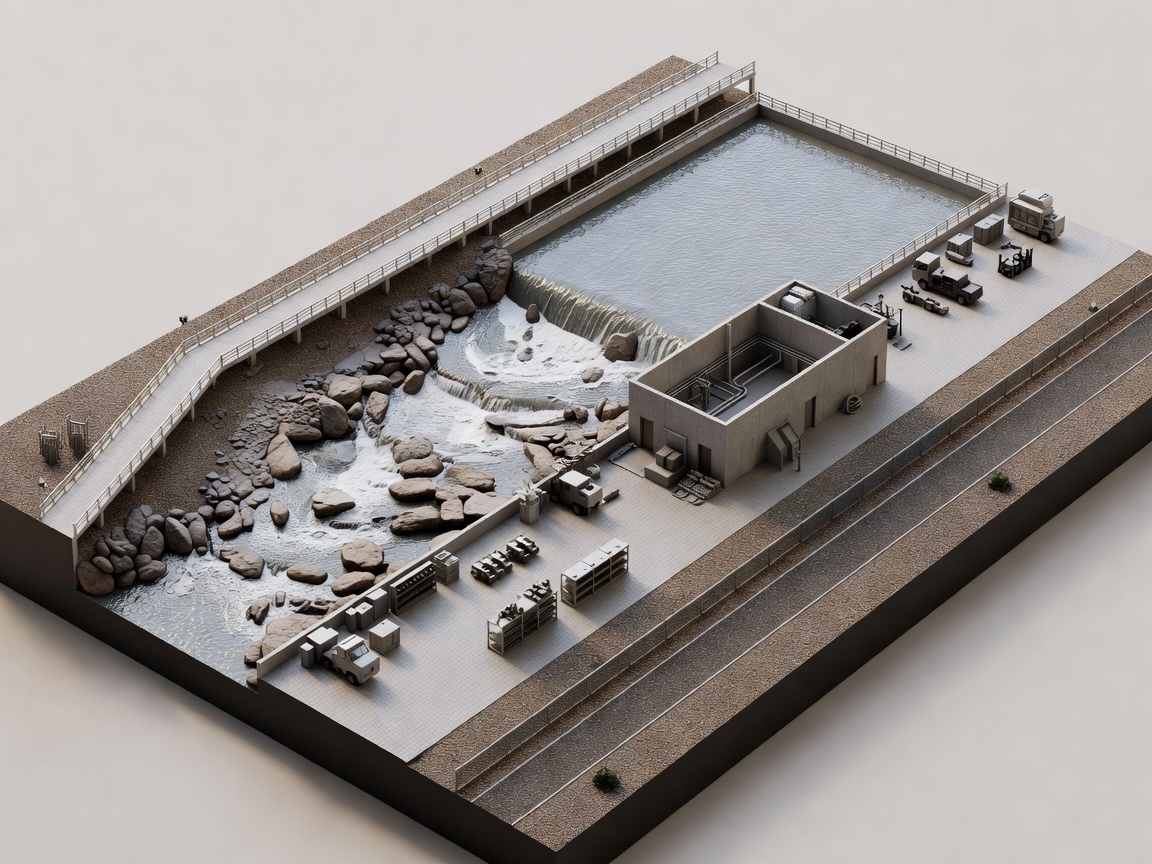
Plant must be accessible for inspection, servicing and eventual replacement. Check how equipment would leave the building, where lifting or handling operations would take place and how service vehicles would reach the relevant area. A component that fits neatly into a small room may be impossible to replace without major disruption.
Channel maintenance raises similar questions. Surfaces, joints, embedded interfaces and drainage features need inspection and repair strategies. Sediment and debris management can require space that is easy to omit from early drawings. Reserve the necessary routes and working areas rather than depending on public paths to become temporary workshops.
Connect commissioning to handover
A handover package should make the asset understandable to the people running it. Relevant drawings, equipment information, operating limits, inspection requirements and commissioning evidence need a coherent structure. A large folder of disconnected documents is not the same as a usable operating system.
Training should address the actual installation and the authority of each role. Operators need to understand the approved states of the system and how to escalate unexpected behaviour. Specialist procedures, including isolation and maintenance controls, must be developed and delivered by the responsible competent parties. This article does not provide those procedures.
Plan the operating sequence
- Establish readiness. Use the venue’s approved processes to confirm that plant, channel configuration and staffing match the planned programme.
- Deliver within limits. Keep the operating setting and user activity aligned with the assessed envelope and relevant restrictions.
- Record and escalate. Capture defects, unusual observations and departures from expected performance through a clear reporting route.
- Review before change. Evaluate proposed layout, equipment or programme changes before they become routine practice.
This sequence is a planning framework, not a start-up checklist. Each site needs its own documented procedures, emergency arrangements and competent supervision. The appropriate checks cannot be determined from the appearance of another venue or from a general web guide.
Measure useful availability
Opening hours alone can hide a weak service. Track whether the facility actually delivers the agreed training conditions, how often restrictions affect the programme and which faults cause repeated disruption. Feedback from coaches can reveal a feature that technically operates but no longer provides reliable reference conditions.
Combine that feedback with maintenance records and resource use. The result should inform planned renewal and targeted improvement, not just annual reporting. A well-kept change log helps distinguish a gradual maintenance issue from a consequence of a recent layout or operating adjustment.
Keep responsibilities and standards distinct
ISO 55001 offers an asset-management framework, while ISO 14001 addresses environmental management systems. Neither is a whitewater course design certificate. Similarly, International Canoe Federation sporting requirements do not replace structural assessment, environmental permissions or occupational obligations. Identify the relevant requirements for the location and intended operation with qualified advisers.
Facilities such as Cardiff International White Water, Tees Barrage International White Water Centre and Dutch Water Dreams illustrate the broader range of settings in which artificial whitewater has been developed. Historical examples are not assurances about present operation or commercial outcomes. Their value here is to prompt whole-life questions before a new project commits to a permanent arrangement.
Outline a facility question